

Choosing a rice variety completely changes the result of a paella. This decision influences cooking point, grain texture, margin for error, ability to absorb flavour, and even final resting time. You probably have never thought about making a Valencian paella with basmati rice, or you may have obtained a “so-so” result when cooking arroz a la cubana with bomba rice, right?
When cooking a paella, many people focus on the sofrito, the stock or the socarrat. And yes, all of that matters. But if you do not know the grain you are cooking, you risk working blindly.
At Arroz Tartana we promote the culture of rice, because we understand that cooking well starts with understanding the product. And few doubts generate as many searches as this one: what is the difference between Albufera rice and Marisma rice. To explain this difference, we rely on the collaboration of the great rice expert Juan Carlos Galbis, an undisputed reference in contemporary Valencian cuisine.
As he himself summarises, both varieties are excellent for cooking paella. Both deliver high-level results. The choice will depend only on what you are looking for in the dish and how you plan to cook it.
Why the rice variety changes your paella
Did you know that rice does not behave the same depending on its internal composition? The amount of amylose in each variety determines:
- Its resistance to cooking
- The speed of stock absorption
- The grain elasticity
- The final texture
- The resting margin
This explains why two rice varieties cooked with exactly the same stock, heat and timing can produce completely different results.
In absolute terms, there is no better variety than another. There is simply the right variety for the result you want to achieve. And before explaining how to cook Albufera rice in paella and Marisma rice, we will explain the differences between them.
What is Albufera rice
Albufera rice is a Valencian variety developed by IVIA (Valencian Institute for Agricultural Research) in Sueca and certified in 2007.
This variety comes from crossing two well-known types: Bomba rice, famous for its resistance, and Sénia rice, valued for its high absorption capacity. The result is a rice with good absorption, medium-high resistance, and a comfortable cooking margin.
This makes it one of the most versatile varieties for paella.
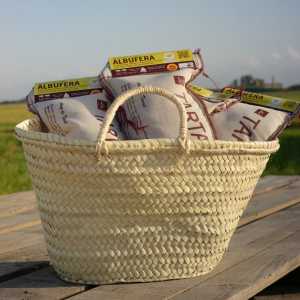
What characterises Albufera rice
Albufera grain has a compact and firm structure. This translates into:
- Firm grain
- Good resistance to overcooking
- Allows proper resting without deterioration
- Uniform result
- Correct flavour transmission
As Juan Carlos Galbis states, this variety behaves in a very noble way in the kitchen, which is why many professional chefs choose it as a safe variety.
What is Marisma rice
Marisma rice was developed in the Ebro Delta from local crosses. Although there is not much detailed public information about its origin, it is different in structure and behaviour. It has lower amylose content than Albufera rice, which completely changes its cooking performance.
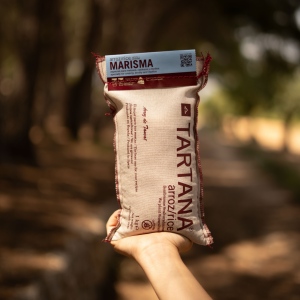
What characterises Marisma rice
Marisma offers:
- Greater elasticity
- A “long A” grain, meaning long and thick grain
- Just enough firmness
- High flavour transmission capacity
- Shorter cooking margin
When well executed, it delivers spectacular intensity. But be careful: it is a more demanding rice, so if poorly managed it can easily overcook.
Differences between Albufera rice and Marisma rice
Since Albufera has more amylose than Marisma, it is more resistant to cooking. Below is the practical comparison that really matters when cooking paella.
Now imagine cooking the same paella with both varieties. Remember that stock proportion in paella depends heavily on pan size and heat intensity: larger pans with little rice increase evaporation speed and therefore require more stock. Stronger heat also dries faster, so more stock is needed.
To make a proper comparison, we must use the same pan size, same heat source, same rice quantity, and same ingredients. Below are the results of this “experiment”.
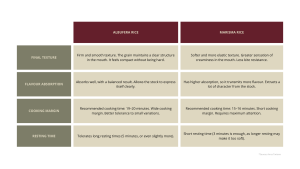
How to cook Albufera rice in paella
Albufera rice, being a shorter or smaller grain, needs slightly more time to hydrate its core.
For this reference we use 1 part rice (100g) to 4 parts stock, and a cooking time of 19 to 20 minutes.
How to cook Marisma rice in paella
Although many people think it needs less stock, it usually works with a similar proportion.
In this reference we use 1 part rice (100g) to 3.5 parts stock, and a cooking time of 15 to 16 minutes.
How to know when rice is perfectly cooked
For both Marisma and Albufera rice there is a technical and reliable way to know the optimal cooking point.
It consists of observing the grains in the second layer of rice. By looking at the white point or “raw pearl” inside the grain, it should have disappeared or become barely visible.
Although it depends on personal preference, if the pearl is still very visible, the rice is undercooked. The final result should be: loose, dry and flavourful grains, with just enough firmness to be felt when chewing without breaking.
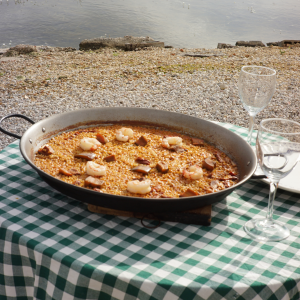
Heat control: where paella is won or lost
Heat and timing control is common to both Albufera and Marisma rice. Before starting your paella, if you prepare your own stock, cooking is usually done at medium-low heat. If you want to learn how to make homemade stock, you can read the related article.
Once you start the paella:
- When cooking the sofrito, heat is generally low.
- When adding the stock, return to medium-low heat.
- When adding the rice, increase to high heat so it boils, and distribute the rice evenly.
- Then reduce to medium-low for 10 minutes so grains cook covered by stock.
- In the final 5–7 minutes, when grains start to appear, lower heat to minimum so they absorb without excessive evaporation.
- To achieve socarrat, ensure no stock remains at the bottom, only oil, then increase heat for 2–3 minutes.
As you know, resting is key. For Albufera rice, 5 minutes or more is fine. For Marisma, 3 minutes is enough because it continues absorbing moisture due to its lower amylose content.
Common mistakes when cooking Albufera and Marisma rice
If we move away from the above, anything can happen. As Galbis says, “practice is the best school”. Common mistakes include:
- Treating all rice varieties the same way
- Letting Marisma rice rest too long
- Ignoring pan diameter and heat source
- Not giving enough attention to Albufera rice due to its versatility
Which variety to choose for your paella
Now you know the decision depends on how you cook and the result you want.
Choose Albufera rice if you want:
- More stability
- Cooking safety
- Firm result
- Comfortable resting time
Choose Marisma rice if you want:
- More flavour intensity
- Greater absorption
- More precision
- A more expressive result
Always remember that Marisma requires greater technical sensitivity and constant attention. And both varieties are excellent, whether for dry, creamy or brothy rice dishes. The choice depends on the cook’s preference.
Two great varieties to understand rice culture
Talking about Albufera and Marisma rice varieties is talking about technique. It is about how small changes in the grain transform the entire dish.
At Arroz Tartana, a 5th-generation farming family cultivating rice in the rice fields of l’Albufera de València, we believe that understanding these differences is part of promoting Valencian rice culture. Because cooking rice means understanding what is in front of you, how it reacts to heat, and what it needs to express itself.
And when you understand that, paella stops being a recipe and becomes pure experience and knowledge.
Thanks again to our collaborator Juan Carlos Galbis for his invaluable rice expertise in writing this article.