

How to make a good sofrito: the foundation of a great Paella
Before the rice, before even the stock, there is a decisive moment that defines the character of the dish: the sofrito. And in Valencian cuisine, we do not take it lightly. It is a technique that has been used for generations and is synonymous with the patience and understanding behind cooking a proper rice dish.
By now, you already know that rice is not just another ingredient. The type of rice determines the final result of your dish, and sofrito is one of the first lessons that teaches us how to treat rice with the respect it deserves.
This article has been written in collaboration with Juan Carlos Galbis, master rice chef and an undisputed reference in contemporary Valencian cuisine. Considered by many to be the finest rice chef Valencia has produced, he has devoted his life to perfecting rice technique through knowledge and deep respect for tradition.
At Arroz Tartana, we promote and preserve Valencian rice culture because we believe that authenticity can only be protected through knowledge. And understanding sofrito means understanding the foundation of many of our rice dishes.
Sofrito as a technique, not a list of ingredients
One of the most common mistakes is to think that sofrito is a fixed combination of ingredients. It is not a rigid recipe. It is a technique — one that applies to paella, seafood rice dishes, mountain-style rice, and many other rice preparations.
In Valencian, we would say cal fer-ho amb trellat — it must be done with judgement, common sense, and understanding.
Each recipe may vary depending on its main ingredient. What never changes is the correct way to work the technique.
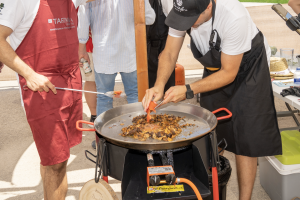
Why sofrito is essential to learning how to cook rice
When we talk about how to cook rice properly, sofrito is where flavour begins to take shape.
It fulfils three fundamental functions:
- It brings aroma and depth.
- It gives structure to the final flavour.
- It prepares the base so the rice grains impregnates with flavours properly.
A rice dish may use an excellent variety of grain and achieve perfect cooking, but if the sofrito fails, the whole dish loses coherence.
The golden rules for making a good sofrito
Choose high-quality ingredients at their optimal ripeness
Good produce is the starting point of everything. A flavourless tomato or low-quality paprika can ruin the foundation before you even begin.
Tomatoes should be fully ripe, fleshy, and balanced in acidity. Whenever the season allows, we strongly recommend using local produce. Whenever possible, we use tomatoes from the Valencian market gardens — not only to support local farmers and friends of the region, but because the flavour of a properly ripened Valencian tomato in season is simply unmatched.
Cut ingredients very finely
Sofrito should not dominate the final dish. Vegetables and other ingredients must be finely and evenly chopped to ensure uniform cooking and to avoid unnecessary prominence in the finished rice.
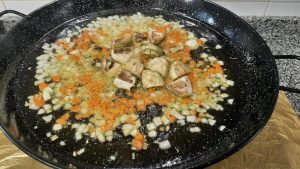
Cook with enough fat and over gentle heat
Extra virgin olive oil is the carrier of flavour. It should generously cover the base of the pan, without excess. The ideal heat is medium or medium-low. Sofrito requires time. If rushed, natural sugars burn and bitterness appears.
Start with the hardest ingredients and finish with the most delicate
Order matters. Begin with the ingredients that require longer cooking times. If your rice includes onion, carrot, or turnip, add them first. Leeks or peppers can be incorporated later. Garlic should be gently golden — never burnt.
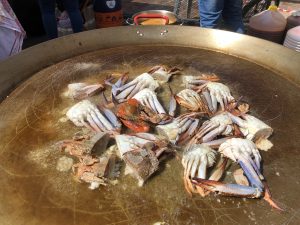
The critical moment: sweet paprika
Paprika must be added off the heat or over very low heat. Stir quickly and immediately moisten with grated tomato or stock. If it burns, it turns bitter and ruins the rice. This simple gesture makes a decisive difference in many paella recipes.
Aromatics and spices, always at the end
Spices and herbs should be added during the final stage to preserve their nuances. A sofrito should not be overloaded. Each ingredient must contribute — not compete.
Time and temperature: where sofrito is won or lost
Sofrito does not tolerate haste.
There are three clear signs that indicate you are doing it correctly:
- The sound changes: it stops evaporating water and begins to fry.
- The colour darkens slightly.
- The oil begins to separate.
When the tomato has lost its moisture and becomes concentrated, the sofrito has reached its perfect point. And this is where the paella truly begins.
A sofrito suitable for all types of rice dishes
This technique applies to:
- Valencian paella
- Seafood rice dishes
- Vegetable rice dishes
- Dry, creamy (meloso), or brothy rice preparations
We have not specified exact ingredients because what we want to transmit is the importance of technique. Each recipe may vary depending on the main product, but the structure of the sofrito remains the same.
You may prepare it directly in the cooking vessel — whether in the paella pan or the pot for a brothy rice — or make it in larger quantities to use when needed.
Common mistakes when making sofrito
Promoting rice culture also means speaking openly about common errors:
- Undercooking the tomato.
- Turning the heat too high.
- Burning the paprika.
- Adding too many ingredients.
- Cutting pieces too large.
When it comes to rice, less is often more.
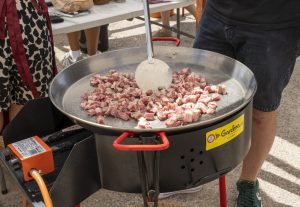
Sofrito as valencian cultural heritage
Sofrito is not learned simply by reading rice recipes. It is learned by observing, repeating, understanding the process — and above all, practising. It is knowledge transmitted from generation to generation.
At Arroz Tartana, we believe that teaching how to cook rice properly is a way of protecting our gastronomic culture. Because when we understand sofrito, we understand something even deeper: cooking rice is not just about following steps in a recipe. It is about becoming part of a tradition that deserves to be cared for, shared, and passed on.
And as the great Juan Carlos Galbis says, rice is not made in a hurry. It is crafted with technique, patience — and trellat.