

How to make a good socarrat: Valencian umami
If there is one moment that creates anticipation around a paella, it is the socarrat. That thin layer of golden, crispy rice that forms at the bottom of the paella and, thanks to its incredible flavour, becomes the most sought-after part of the dish.
However, one thing should be made clear: socarrat does not happen by chance. It is created at the very end, when the rice has reached its perfect cooking point and the cook decides to take the paella one step further.
At Arroz Tartana, we see socarrat as one of the most recognisable expressions of Valencian rice culture. In fact, we cannot imagine a great paella without its treasured socarrat. That is why, once again, we have collaborated with Juan Carlos Galbis, one of the leading rice experts in contemporary Valencian cuisine, to explain how to achieve the perfect socarrat.
What is socarrat?
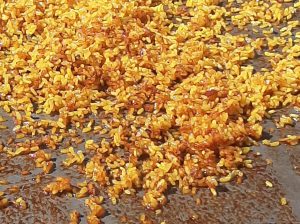
Socarrat is the layer of rice that lightly sticks to the bottom of the paella and develops a golden colour and crispy texture thanks to the action of heat.
Its flavour is intense, toasted and unmistakable. In fact, many Valencians consider it the most delicious part of a well-made paella.
To achieve it properly, the rice must already be fully cooked, dry, and with no remaining broth at the bottom of the pan. At that point, the olive oil and fats released by the proteins that remain at the bottom begin to heat up and fry the grains that are in direct contact with the surface of the paella.
And that is where socarrat is born.
What socarrat is not
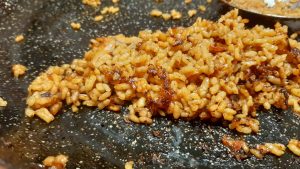
One of the most common mistakes is confusing socarrat with burnt rice. Good socarrat is golden. Bad socarrat is black.
When rice burns, it develops bitter and unpleasant flavours that ruin the final result. The goal is not to char the bottom of the pan, but to create a controlled frying process that adds texture and flavour.
And be careful: the difference can be a matter of seconds.
How to make a good socarrat step by step
Once the rice has reached its ideal cooking point:
- Make sure there is no broth left at the bottom of the pan.
- Maintain or slightly increase the heat (without overdoing it).
- Listen to the paella. The sound changes and a gentle frying begins.
- Watch the process carefully for one or two minutes.
- When the desired golden colour is reached, turn off the heat.
- Let it rest briefly before serving.
There is no single perfect point. Some people prefer a light and delicate socarrat, while others enjoy a more pronounced toasted finish.
The key is to stop the process before any bitterness appears.
The trick used by rice masters
Juan Carlos Galbis shares a simple technique for controlling the socarrat.
It involves carefully lifting a piece of meat from the paella and looking at the rice underneath. This allows you to check directly how the rice at the bottom is browning without disturbing the cooking process.
Then, place the piece of meat back in its position and repeat the check as many times as necessary.
It is a practical way to monitor the process visually and avoid unpleasant surprises.
What factors influence socarrat?
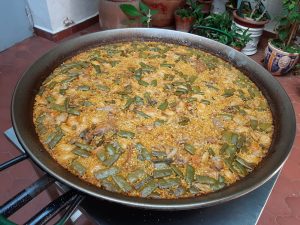
Even when the technique is correct, several factors can make it more difficult to achieve a good socarrat.
Excess starch
Some rice varieties release more soluble starch during cooking. This causes the broth to thicken more than usual, and part of that starch settles at the bottom of the paella.
When it is time to create the socarrat, this layer can burn quickly. The grains stick together and the final result suffers.
That is why it is important to work with high-quality rice that has been properly processed and carefully selected.
Grain quality
Good rice should have uniform grains, very few broken kernels and a consistent appearance. Broken grains release more starch during cooking and increase the chances of the bottom becoming too delicate during the final stage.
A good grain selection helps achieve a more even cooking process and a cleaner socarrat.
The rice variety
Not all rice varieties behave the same way when making socarrat.
Rice varieties with a visible pearling effect tend to perform better in traditional Valencian cooking because they offer a balanced combination of absorption, texture and the ability to develop that characteristic toasted layer.
In contrast, rice varieties with a more translucent appearance (or without pearling) tend to be more resistant to cooking, thicken the broth less and make it more difficult to achieve a well-developed socarrat.
Common mistakes when making socarrat
- Trying to make it while there is still broth at the bottom of the pan.
- Increasing the heat too much in an attempt to speed up the process.
- Waiting too long and ending up burning the rice.
- Using rice with many broken grains or poor-quality rice.
- Confusing a golden socarrat with burnt rice.
Socarrat as part of rice culture
Socarrat is not mandatory. There are excellent paellas without socarrat and excellent paellas with it. It is a matter of personal preference and the cook’s choice.
What is truly part of Valencian tradition is understanding when to make it, how to make it and why it happens.
At Arroz Tartana, we believe that understanding these details helps people better appreciate rice culture. Because a great paella does not depend on a single step, but on a series of good decisions made throughout the cooking process.
Socarrat is one of the last of those decisions. And perhaps the most eagerly awaited one.
As Juan Carlos Galbis often says, practice is the best teacher. Socarrat requires observation, patience and an understanding of how rice behaves at every stage of cooking.
So, are you ready to experiment with socarrat in your next paella?